For years, I was privileged to walk in the forest nearly every day—often multiple times a day. My constant companion was Diego, our beloved golden retriever. But when we lost him last January, the walks stopped. While I still returned to the forest to run or bike, walking without Diego simply didn’t feel right. The emotional barrier was too high.
Then came an assignment from the Leadership Training programme at the UNDP Conscious Food Systems Alliance (CoFSA), which I am currently undertaking. The task? Take a nature walk and reflect deeply on the inner and outer dimensions of the experience. It was exactly the push I needed to break through the grief Diego’s parting left in our lives.
As I walked, I found myself navigating a series of crossroads. They immediately made me think of choice architecture—and how the options presented to us shape our world.
Look at these three images:
- Photo №1 (The Standard Choice): Two asphalt-paved paths. This is where society usually leaves us—forcing a choice between two heavy environmental-footprint options.
- Photo №2 (The Transition): An asphalt walk vs. a nature path. A clear choice between high and low impact, if we are lucky enough to have it.
- Photo №3 (The Ideal): Two nature paths. Though human-made, both represent a low-footprint future.
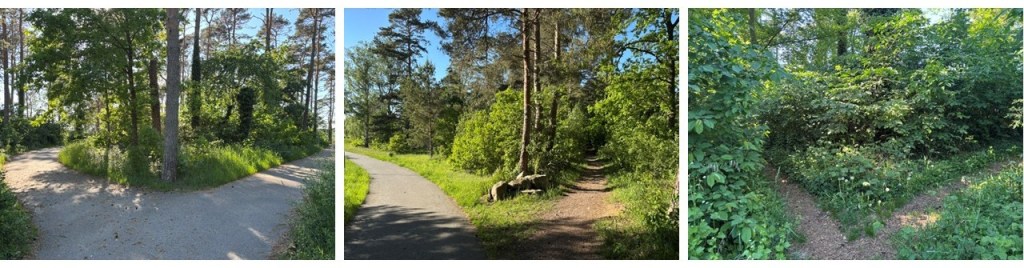
Our food systems should naturally present us with the third scenario. Yet, today’s dominant economic choice architecture rigorously restricts us to the first two. Powerful financial interests keep those asphalt paths paved. However, I see a shift: more and more people are actively seeking out that third path. By continuing to walk it, we make it visible, inviting, and welcoming for others to follow.
Immediately after sending these thoughts to my cohort, my mind began connecting deeper dots. The crossroads reminded me of a classic mathematical probability model: The Pólya Urn Experiment.
Imagine an urn with two balls: one black, one white. You draw one at random, put it back, and add another ball of that exact same color. Because drawing a color increases its future probability, the system rapidly develops a positive feedback loop. Over time, the urn doesn’t settle into a balanced 50/50 ratio. Instead, it freezes into a highly skewed distribution governed entirely by early, random fluctuations.
In systems thinking, this is the «Success to the Successful» archetype. It’s a zero-sum, winner-takes-all dynamic. Whether under capitalism, communism, or traditional societies, it creates a vicious cycle: early opportunity breeds success, and success traps resources for a select few by sheer statistical probability.
«In a system with fixed resources, if party A gains an early advantage over party B, A can use that advantage to acquire even more resources. Meanwhile, party B’s disadvantage grows over time, leaving it less and less able to generate additional resources.»
Sound familiar? It is the exact principle that perpetuates generational wealth and allows mega-corporations to monopolize market share. The more white balls we feed back into the system, the more inevitable a white-ball future becomes. A self-propelling, locked-in outcome.
We cannot easily rewrite the structural rules of global inequality overnight. But we can nudge the urn.
We do this through the compounding power of our daily choices. Every single time you make a conscious decision to back a product, service, or food system with a verifiably low environmental footprint, you drop a new kind of ball into the urn. You skew the probability. You increase the chances that the next choice coming out of the system—and the next, and the next—will be a sustainable one.
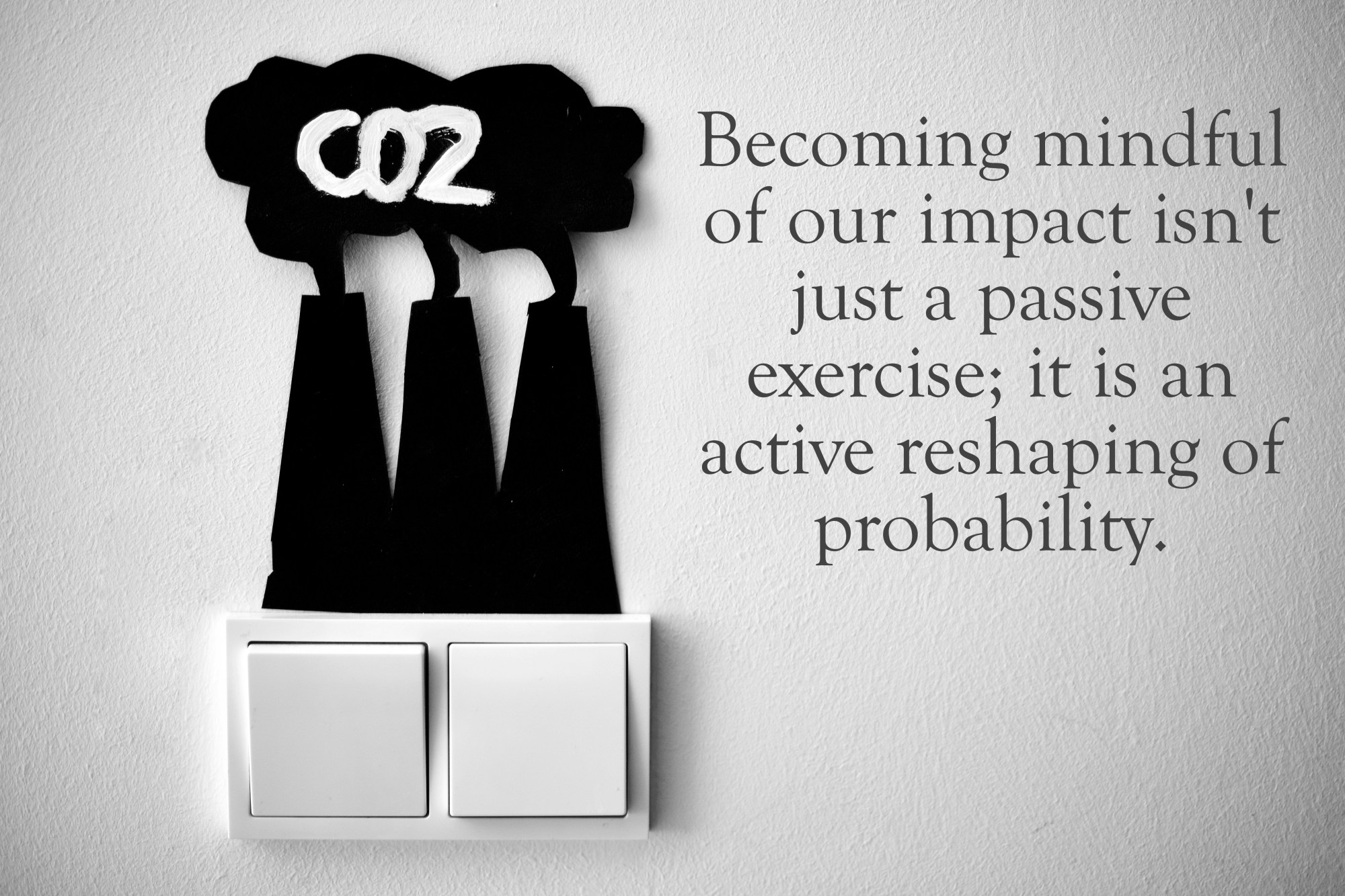
Becoming mindful of our impact isn’t just a passive exercise; it is an active reshaping of probability. With collective will, commitment, and patience, we can rewrite the feedback loops.
We don’t get to change the mathematical law of Success to the Successful. But by consciously choosing the nature path, we absolutely get to change what «success» looks like.

