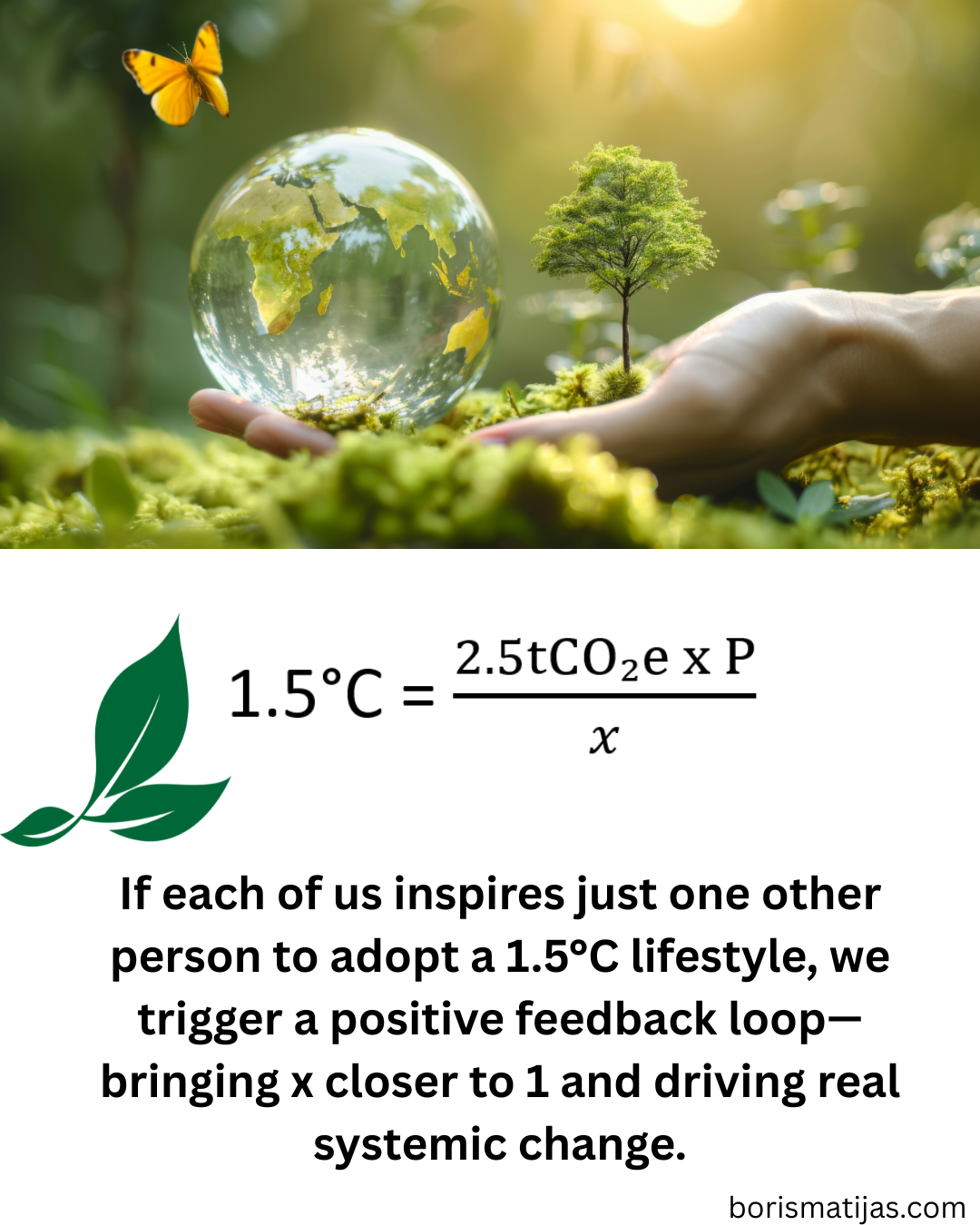
Are personal lifestyle changes enough to hit the 1.5°C climate goal?
Not on their own. It comes down to a simple formula:
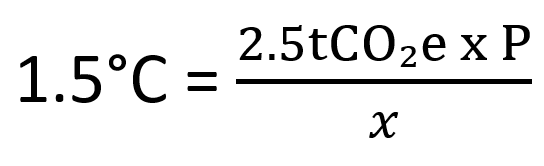
Here is how this social (relational) arithmetic breaks down:
To reach the Paris Agreement goal of keeping global warming below 1.5°C, it takes individual effort to keep CO₂ emissions below 2.5 tonnes per person/year. This is nearly double today’s global average of 4.8 tonnes per person per year. The average spans from 70 tonnes per capita in Qatar to near 0 tonnes per capita in Tuvalu.
This is where the P from the equation comes into play. It refers to the social, economic, and political power of any individual. It stands for the power behind personal choices and the influence these have on global GHG emissions. The P relates to one’s impact on society as a consumer as well as one’s impact in the value chain as a stakeholder.
The P is the sum of one’s entire civic and professional impact on climate change. Hence, driving the latest model of electric vehicle, that is charged by solar panels installed in the carbon-neutral house that separates waste and reuses water, is fantastic… as long as you are not a CEO of an oil company, or have any other decision-making role in a high-polluting company or organization.
The P stands for the entirety of one’s choices (personal and professional) and its ability to make decisions that promote social and technological innovation and solutions that help to mitigate climate change. Our real impact is the sum of both our personal choices and our professional leverage within the value chain.
But lastly, all this effort gets divided by x. It is the unknown that stands for human behaviour.
We already have efficient strategies, technologies, policies and enough economic resources to prevent climate change from accelerating. However, until pro-environmental behaviour and sustainable practices become social norms shared by the vast majority of humanity, the first part of the equation (the individual one) will not have any significant impact. The x is deeply embedded in the human-centred mythology that justifies the depletive nature of our interaction with Nature.
But mythologies change. They evolve through conversations.
The success of 1.5°C depends on the conviction behind the first part of the equation. The stronger it is, the more contagious it gets. All it takes is for each one of us to get at least one other person to join, and the condition for self-driven feedback is met.
With each new person adopting the 1.5°C lifestyles, we are one step closer to reaching the tipping point.
The more we do to spread the upper part of the equation (

