“We collectively create results that nobody wants” alerted Otto Scharmer, during the talk held at last week’s IDG Summit. What tends to happen when these unwanted results show up is that we go for quick fixes and short-term solutions. Those eventually end up creating future problems and so, over and over again, we simply keep on spinning downwards, as the latest report on the state of Planetary boundaries confirms.
The conditions are dire and require hard choices to be made. But, as long as our leaders and decision-makers remain detached from the reality of the communities in which they engage, decisions will keep on bringing the results that nobody wants. Today, more than ever, it is the community engagement that is required to avert the disaster we are facing and create better conditions for the generations to come.
Today, more than ever, we need strong and engaged communities. And all institutions share responsibility for their development.
According to ISO 26000, (a standard that provides guidance to those who recognize that respect for society and the environment is a critical success factor), a community is a group of people who have particular characteristics in common. Therefore, community involvement and community development are both part of sustainable development and each organization is a shareholder in the community. For that same reason, they all share a common interest in the community and should contribute to community development.
In other words, community development is enhanced by socially responsible behavior and this behavior is very much aligned with the “taking care of the soil” mentality. This was part of the call Otto Scharmer made while addressing the practice of shared awareness, which is aimed at providing an understanding of the processes that affect what he referred to as the ‘social field’.
That is a term used to define a social system with its soul. With its interiority and its own relational dimension. To put it into perspective, Scharmer recalled growing up on the family farm. His parents were among the pioneers in regenerative farming and since his early days, he became aware of how important it is to pay attention to the quality of the soil. Of getting engaged in keeping and improving its quality. That is the groundwork upon which all the rest of the farming results rely upon.
I have admired Scharmers’ work for some time now. Particularly the development of a change management method called U theory. His words took me back some weeks ago, to a trip I made with my brother Igor. It was part of the ‘ritual’ of reconnecting we do every time I travel back to Belgrade where he lives. Due to diverse circumstances, and life choices, I have been living abroad for nearly all of my adult life, and having these small rituals is a way of “taking care of the soil”. Because, no matter where my growth is, my roots will always remain with my family.
The ‘ritual’ consists of getting away for a day. And since we both love a good wine and the stories it tells, each time I come my brother picks up a small winery to visit. This last trip, some weeks ago, was a wonderful discovery of McCulloch Winery. This winery, carrying a very unexpected name for Serbia, was founded by Don McCulloch, a retired British royal family bodyguard, who found love in the Balkans and settled on the slopes of Fruska Gora. There he devotes time to winemaking, one of his greatest passions.
But his origin is not the only thing that differentiates Don from the rest of the local winemakers. He is using a biodynamic approach to wine-making captivates holistic and ‘old world’ methodologies to work with nature, rather than fight it. No artificial fertilizers or chemicals are used on the land or plants to optimize flavor, quality, and individuality.
Don relies on the symbiotic processes that the natural conditions provide and “taking care of the soil”. On that path, he is placing focus on the quality and not the quantity of the wine production. It is a path less taken, because of the short-term expectations that often place economic return above anything else. But Don is in it for the long run.
Instead of using artificial fertilizers, pesticides, insecticides, or herbicides to dormant the symptoms, Don is addressing the underlying condition, which is the quality of the soil. This allows him to build a healthy relationship between the nutrient flows and the quality of the grape growing.
This is where the “Land system change”, one of the planetary boundaries we have pushed out of balance, comes into play. Nitrogen (N) and phosphorus (P) are two of the main elements that constitute fundamental building blocks of life. According to the Stockholm Research Institute, their global cycles have been markedly altered through agriculture and industry. For both N and P, the anthropogenic release of reactive forms to land and oceans is of interest, as altered nutrient flows and element ratios have profound effects on ecosystem composition and long-term Earth system effects.
What P and N are for the climate and biosphere integrity, V and N are for our communities.
Same as soil needs healthy nitrogen and phosphorus processes so does a community need values (V) and norms (N). And as Scharmer reminded us, taking care of the soil requires humility. It requires touching, smelling, feeling, and sensing the soil. Listening and observing its needs.
It requires being down to Earth. Walking and cultivating the common ground.
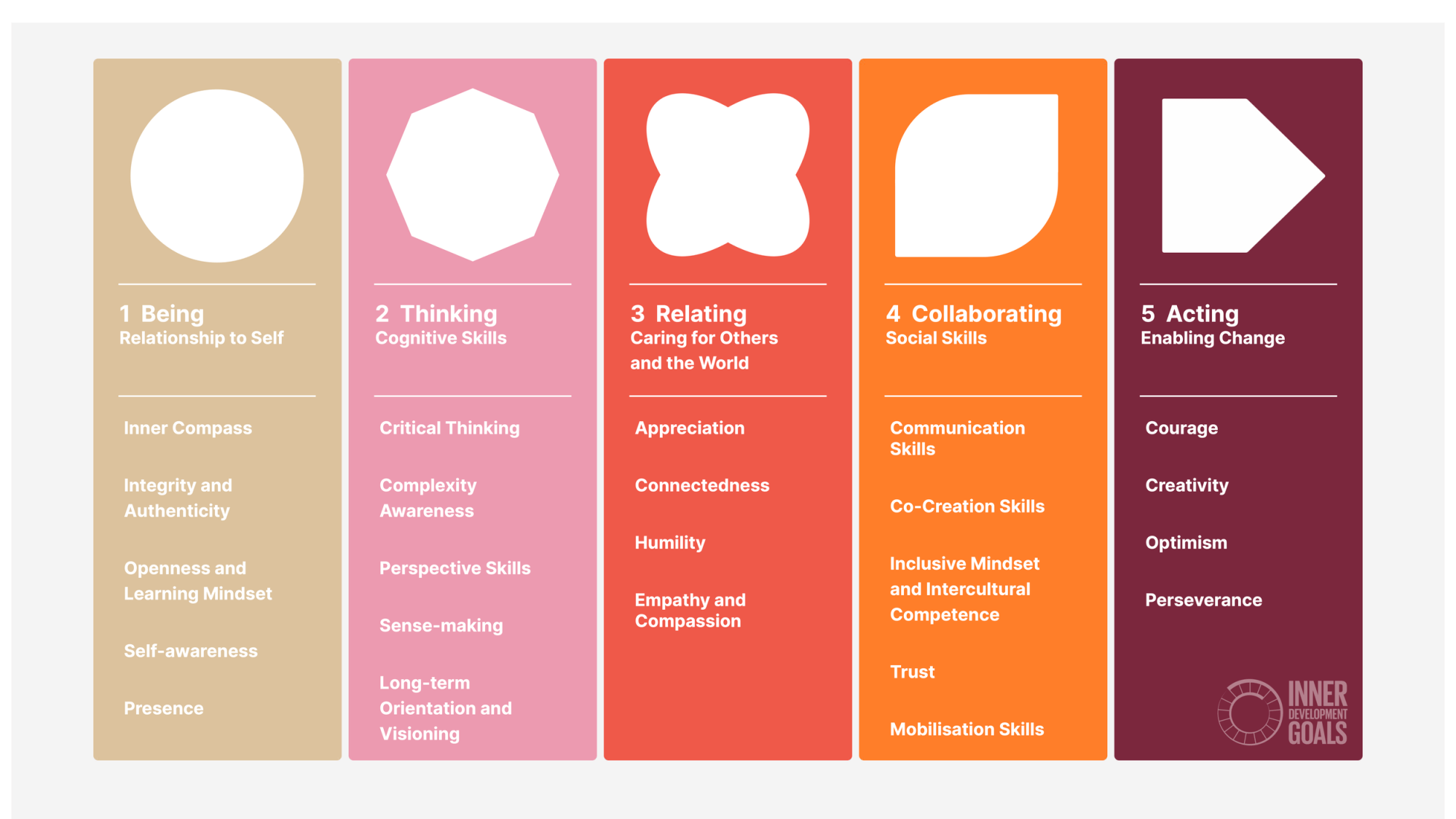
If Sustainable Development Goals are the roadmap, the Inner Development Goals are the compass to be used on the ground. Together they represent both the map and the territory. However, before taking any steps, a good leader should ask him/herself:
Am I having my feet firmly on the ground?
Am I taking care of the soil?
Answers will come through the mindful practice of shared awareness. All it takes is humility, commitment, and acknowledging that it is the strong communities that sustain successful businesses and not the other way around.
After all, if we ‘take care of the soil’ Being=>Thinking=>Relating=>Collaborating=>Acting will give results that we all want. Here, on our common ground.

 Boris Matijas