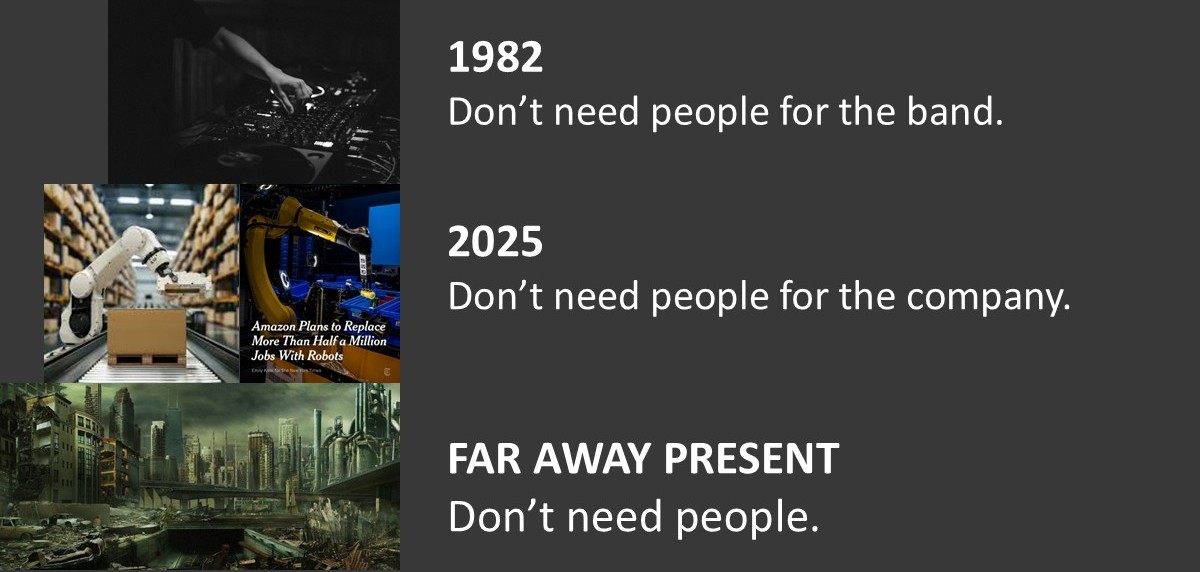
It all started with The Hacienda – the mythical club that opened in Manchester in 1982. It was a place where the DJ became the main attraction, making a traditional «band» less necessary for the party. The dance music vibe was set by a single person behind the DJ controllers, players, turntables, and mixers.
The traditional set-up of performing music with multiple people composing a band began to give way to a one-man show backed by electronic equipment.
Then came 2025 and Amazon. A leaked internal document shows that the company that changed how people shop has a far-reaching plan to automate 75 percent of its operations. In the process, the company plans to let go more than half a million people.
AI is shaping the present and future of work, and many seem happy about the efficiency it brings.
It is beyond any doubt that AI has far greater computing and problem-solving capacity than we humans do. And while its development widens that gap at an incredible pace, it also threatens to reshape human thinking altogether. It’s starting to feel more mechanical as well.
But, as Byung-Chul Han says, «Human thinking is more than computing and problem solving. It brightens and clears the world. It brings forth an altogether world.»
AI is part of an altogether different world, born of human thinking. But if our thinking becomes mechanical, if we give way to computing and problem-solving at the cost of sense, purpose, and hope-seeking, we will lose the only advantage we still have.
If computing becomes the ultimate goal of thinking, artificial intelligence, not controlled by emotional intelligence, will eventually come up with an equation in which humans don’t count; therefore, we will be a problem.
From there on, AI’s problem-solving capacity will take over, and its efficiency will ensure that any problem gets solved. No questions asked.
So, now, while we still have time to ask questions, let’s get back to the one Joan Subirats posed (not so) long ago:
«Ladies and gentlemen, new technologies are the answer. What was the question?»
“Señoras y señores, las nuevas tecnologías son la respuesta. ¿Cuál era la pregunta?
 Boris Matijas