
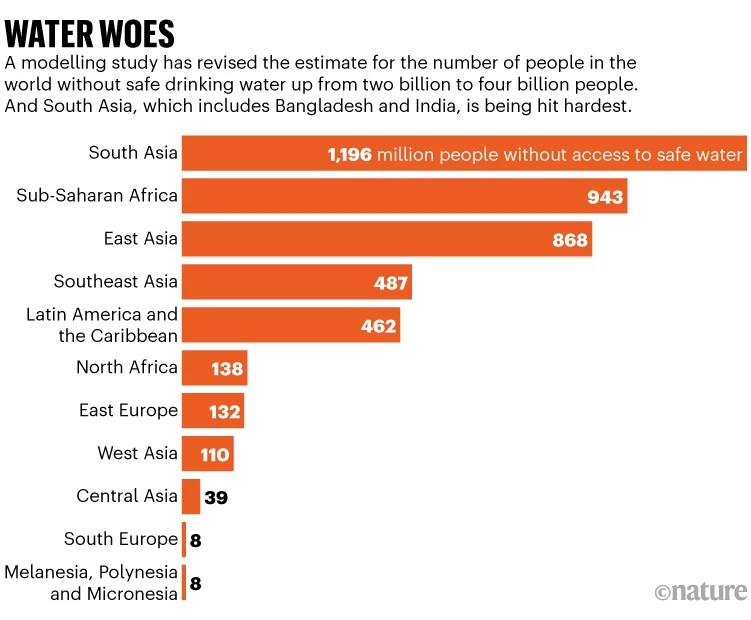
More than half of the world’s population, 4,4 billion people to be precise, is living without access to safe and accessible water, according to a study published in Science. At the same time, 5.35 billion people have access to the internet worldwide, according to Forbes. And while the number of internet users is expected to reach 7.9 billion by 2029, there are no clear indications that the number of people with access to clean water will come anywhere near those figures.
That is not something to think about.
It is something to act about!
If this massive gap between access to the internet and water is the answer, we must have asked the wrong question from the beginning. So, let’s get back to it again:
Why do we need more internet?
And to get the answer right this time, here is the best visual guide we have at our disposal:

«People who don’t have access to clean water may be too sick to work and provide for their families. Food shortages can affect an entire area when there is not enough clean water to grow crops. Women and girls often need to spend most of their time carrying water from distant sites, leaving no time to work or go to school. Conflicts over water can erupt into war, causing additional suffering and poverty.»
Water is a fundamental human right because water is a basic human need. The internet is not.
We can live without the internet. We can’t live without water.
So, unless we start answering the question guided by Agenda 2030, the Internet of Things and AI will lead to even more inequalities. Hence, this inevitably leads to more poverty, conflicts, and violence.
That is where Artificial Intelligence and Common Sense collide. While lacking bodily experience, AI can’t grasp why we need clean water access. For us, it is common sense for AI it is data.
Humans drink water, not data. So, we need to bring back the common sense and remind ourselves that the answer starts and ends with the SDG 1:
No poverty.
Because if this is progress, we are progressing the wrong way.
 Boris Matijas