
– What are you working with?
– I work as a sustainability consultant.
– You mean all this with the climate and all?
– Eh, yeah, in a way.
– Well, you got a lot of work to do. Things don’t look good at all.
– Yes, we all need to do more.
– Ya’right! Say it to those Chinese and the Indians.
– It still doesn’t mean we should stop doing all we can.
– Yes, you are right.
Unfortunately, I had this conversation not with the Swedish prime minister or the environmental minister but with one of the neighbors from my village.
Sweden will miss several of the EU’s climate targets for 2030. This is evident from the government’s climate plan, submitted to the EU Commission at the end of June (Dagens Nyheter). Besides the environmental damage and potential fines from the EU it faces, the worst is the message and the attitude it transmits to the rest of the world.
The government that disposes of my, and all other people working in Sweden, tax money has informed the EU that it will miss the target on how much climate emissions from road transport, agriculture, and heating of buildings must be reduced, as well as the target on how much greenhouse gases must be absorbed by forests and land.
One part of the government’s argument is that climate change is a global question, hence alluding to shared responsibility while avoiding its own. So, practically, the Swedish government is showing the same mindset as my neighbor: Since the Chinese and the Indians are not doing it, we do not want to either. While my neighbor has retracted, the Swedish government, which is conditioned by the support from the far-right and climate-skeptic Swedish Democratic party, doesn’t seem to be planning on doing it.
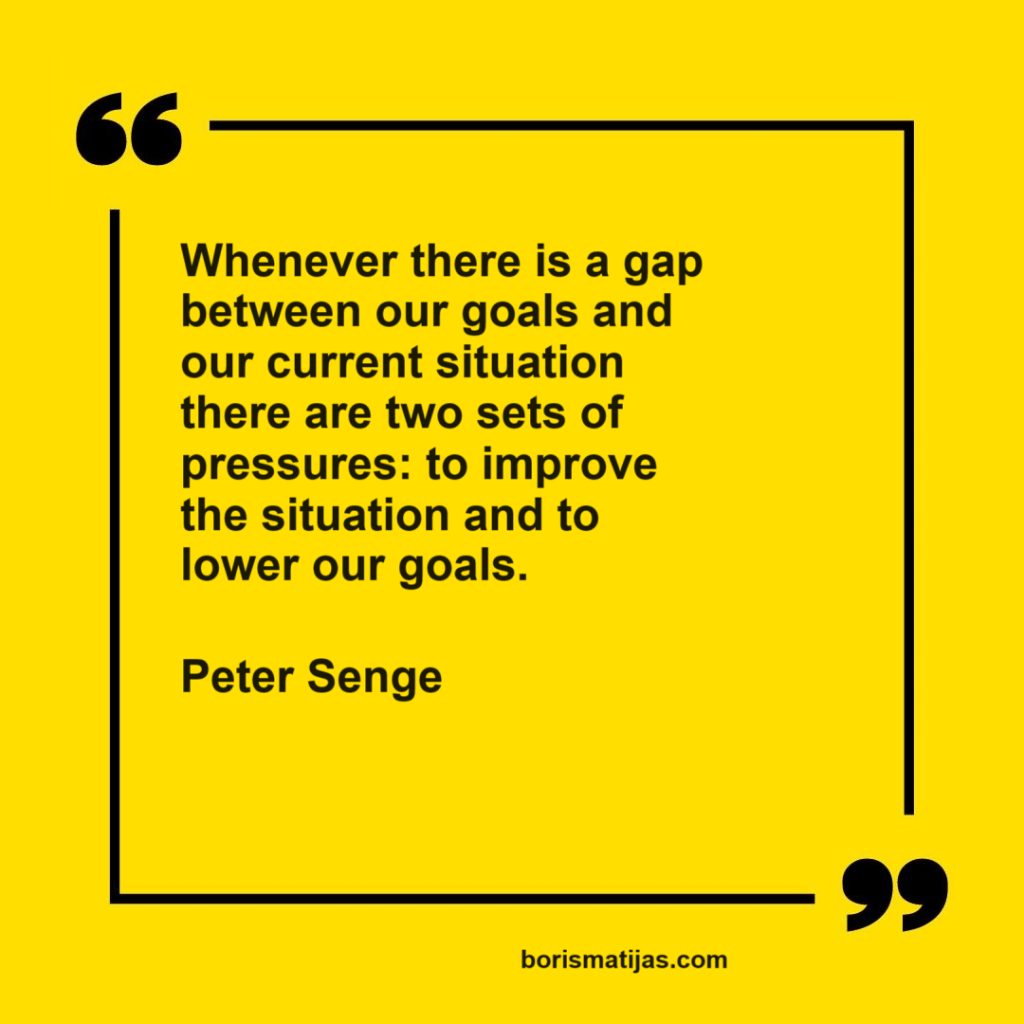
To do so, to retract, would be an exercise of personal mastery. The one that was advised by Peter Senge when writing that «Whenever there is a gap between our goals and our current situation there are two sets of pressures: to improve the situation and to lower our goals.»
While climate change progresses, we don’t have time to lower our goals. There is only one way, only one Agenda to follow, and it is the moral imperative for all those in power to make decisions that will improve the situation and secure conditions for achieving net zero greenhouse gas emissions before 2050. It is time to show personal mastery instead of political jugglery.
 Boris Matijas